
Pronunciation: Consonant and vowel sounds
-The accent we will study today is the present-day version of the English accent which has been considered standard for decades by phoneticians- Professor Malfoy says. A couple of students who belong to Gryffindor keep talking even when the teacher has started her lesson. She holds her wand shouting-. Be quiet or you won't be able to talk again! Ten less points for Gryffindor.
The accent has been known for nearly a century as RECEIVED PRONUNCIATION, or by its abbreviation, RP. The choice of symbols for the representation of RP is one which has provoked much discussion, but since the 1980s there has existed, largely as a result of pressure from the major ELT publishers, a de facto standard set of symbolization conventions which has remained almost unchanged to the present day. It is widely accepted that some modification of these conventions is needed to take account of observable changes in the pronunciation of English, but it is felt to be important that such modifications should not be introduced without general agreement among practitioners of English phonetics so that the benefits of a common system of transcription enjoyed over the last twenty or thirty years should not be lost. An alternative set of transcriptions has, however, been used in the Oxford Dictionary of Pronunciation (Upton et al. 2001).
CONSONANTS:

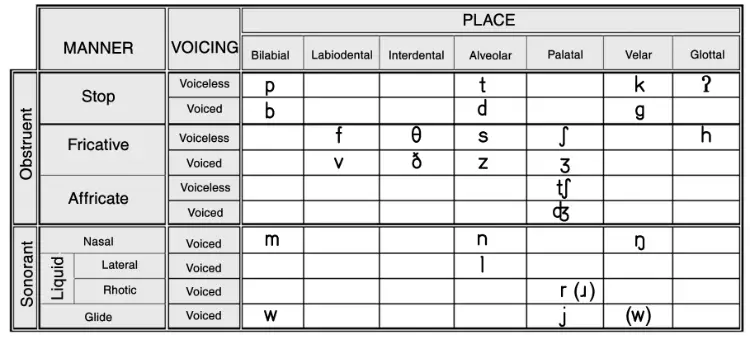
VOWELS:
 |
-RP is traditionally described as having a large inventory of vowels that can be grouped into
SHORT VOWELS, LONG -VOWELS and DIPHTHONGS. The diphthongs may be subdivided into
CENTRING diphthongs (ending in /ə/) and CLOSING diphthongs which end in either /ɪ/ or
/ʊ/. The number of these vocalic elements is around twenty, but the conventional view that
these twenty or so elements are all discrete phonemes of the language is something that is
open to counter-argument: a much more parsimonious analysis is possible. It is noticeable
in this accent that unstressed vowels are much shorter than stressed ones, and are frequently
centralized.
It should be understood that the terms ‘long’ and ‘short’ should be seen in relative terms:
the vowels of both classes are subject to the lengthening and shortening effects found in
English, with the result that a ‘short’ vowel may, in some contexts, be longer than a ‘long’
vowel in a different context. The length mark ː is used to mark the long vowels.
-The SCHWA vowel is of great importance: though it
has no unique representation in spelling, and is often pronounced so weakly as to be almost
undetectable, it is the most frequently-occurring vowel in this accent.
-The vowels may be represented on Cardinal Vowel charts as shown below. It will be
noticed that the position of some of the symbols is quite far removed from the Cardinal
(or IPA) value of those symbols (see for example /æ/, /ɔ:/, /u:/, /ʌ/, /e/); this is largely for
historical reasons, illustrating the need for a modernized transcription. A further symbolization
problem concerns diphthongs: in many cases the vowel glide implied by the symbols in such
vocalic elements is so small as to be almost undetectable, so that the contrast between, for
example, day and dare may appear to be due to the difference between [ eː] and [ɜː]. A closing
diphthong can have a /ə/ vowel attached to it (e.g. fire /faIə); the resulting complex vowel
unit may be classed as a TRIPHTHONG if it is pronounced as a single syllable, but it is often
almost impossible to detect any vowel glide in such an element: see for example the vocalic
part of the first syllables of fire-engine, Ireland, usually being
represented as /aIə/. Typical formant frequency values for the vowels and diphthongs may be
found in Gimson 1962 (ed. by Cruttenden, 2001, pp. 98–102).

There can be some phonological processes which can modify the sound of consonants or vowels:
| Assimilation (Consonant Harmony)
One sound becomes the same or similar to another sound in the word
| |||
|---|---|---|---|
| Process | Description | Example | Likely Age of Elimination** |
| Velar Assimilation | non-velar sound changes to a velar sound due to the presence of a neighboring velar sound |
kack for tack; guck for duck
| 3 |
| Nasal Assimilation | non-nasal sound changes to a nasal sound due to the presence of a neighboring nasal sound |
money for funny; nunny forbunny
| 3 |
| Substitution
One sound is substituted for another sound in a systematic way
| |||
| Process | Description | Example | Likely Age of Elimination** |
| Fronting | sound made in the back of the mouth (velar) is replaced with a sound made in the front of the mouth (e.g., alveolar) |
tar for car; date for gate
| 4 |
| Stopping | fricative and/or affricate is replaced with a stop sound |
pun for fun; tee for see
doo for zoo; berry for very
chop for shop; top for chop; dump for jump; dat for that
|
/f, s/ — 3
/z, v/ — 4
sh, ch, j, th — 5
|
| Gliding | liquid (/r/, /l/) is replaced with a glide (/w/, /j/) |
wabbit for rabbit; weg for leg
| 6–7 |
| Deaffrication | affricate is replaced with a fricative | ship for chip; zhob for job | 4 |
| Syllable Structure
Sound changes that affect the syllable structure of a word
| |||
| Process | Description | Example | Likely Age of Elimination** |
| Cluster Reduction | consonant cluster is simplified into a single consonant |
top for stop
keen for clean
|
with /s/ — 5
without /s/ — 4
|
| Weak Syllable Deletion | unstressed or weak syllable in a word is deleted |
nana for banana; tato for potato
| 4 |
| Final Consonant Deletion | deletion of the final consonant of a word | bu for bus; no for nose; tree fortreat | 3 |
*These are common phonological processes (patterns). The list is not exhaustive.
**Individual differences can be significant.
| |||
Bibliography:
-Peña-Brooks, A., & Hegde, M. N. (2015). Assessment and Treatment of Speech Sound Disorders in Children: A Dual-Level Text. Austin, TX: PRO-ED.
-Roach, P. (2004). British English: Received Pronunciation. Journal of the International Phonetic Association, 34(2), 239-245. doi:10.1017/S0025100304001768
-Shipley, K. G., & McAfee, J. G. (2016). Assessment in speech-language pathology: A resource manual. Boston, MA: Cengage Learning.
Comments
Post a Comment